Matthew Wilkinson
Elegy for the Unyielding appeared in Edition #18 of So Fi Zine. You can read the full edition here.
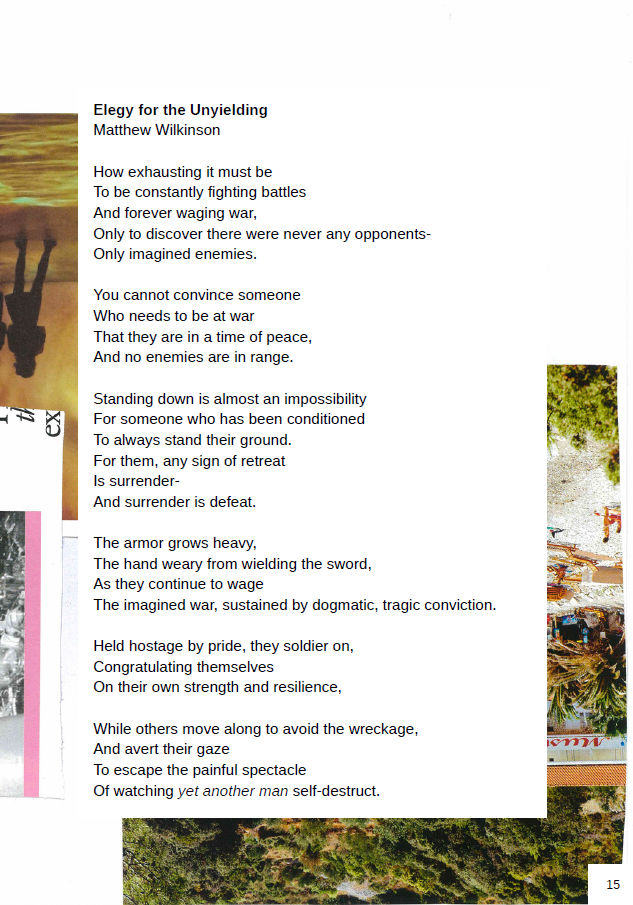
I did not mean to write this poem. It made its way onto paper during a solo writing retreat as I was reflecting on my research and began to connect it to personal experiences.
I have spent the last decade or so researching aggression, mental health, and masculinity. This wandering path led me through the literature on narcissism and sociopathy, and I was struck by how intimately connected these constructs are to masculinity in our society. By default, we tend to attribute such traits to individual psychology, but it is our socialization—how we learn to be boys and men—that so often gives rise to them.
So, while the inspiration for this poem grew out of my scholarly work, it also emerged from my own lived experience. Throughout my life, I have witnessed men who have lost their careers, their families, their businesses—and, in some cases, their lives. A common thread runs through them all. Once you see it, once you recognize this story, you start to notice it everywhere.
Men are socialized into a masculinity centered on stoicism, dominance, competitiveness, and independence. Many come to internalize what bell hooks (2004) calls the “dominator culture,” where the core of identity for a man is defined by “the will to dominate and control others” (p. 115), and where “real men must prove their manhood by idealizing aloneness and disconnection” (p. 121).
Men are taught to “create a false self,” to “live the lie, [and] to be perpetually deprived of an authentic sense of identity and well-being” (hooks, 2004, p. 138). They are destined to “always wear a mask” (p. 138); but they do not know this—or cannot admit it—because this path is marked by denial and self-deception, where integrity is performed rather than lived. This illusory self sets them on a path toward pain and self-destruction. The warrior mask becomes fixed, and they soldier on—always searching for an adversary to give their lives meaning. Do not show fear. Do not reveal weakness. Do not admit fault. Stand your ground. Do not yield. Stay the course.
Yet there is some sympathy to be had here. These men were socialized into this way of being. And, while the harm and trauma many of them cause are undeniable, and accountability must rest with them, we also need to extend our attention and critique to the social and cultural environments that shaped them. These forces molded them and held them in place, setting them on a tragic path and denying them off-ramps along the way. It is a path that feels all too familiar.
The poem, then, arises from this tension: between critique, grief, and compassion, between what men have done and what our culture has done to them, between destruction and the possibility of redemption.
 SO FI ZINE